
Lidar or Cameras: What the Regulator, the Recall Notices and the Price Curve Show
How CodoraTech is funded: CodoraTech is supported by advertising and, in some articles, by affiliate links. Where an article contains affiliate links, we say so at the top of that article.
At Tesla’s Autonomy Day on 22 April 2019, Elon Musk said that lidar is a fool’s errand and that anyone relying on it was doomed. The more substantive version of the argument came from Andrej Karpathy, then Tesla’s senior director of artificial intelligence, who called lidar a shortcut that sidesteps the fundamental problems of visual recognition, a crutch giving a false sense of progress. Seven years on the engineering question is not settled, but two things around it have changed: a US regulator has escalated an investigation into camera visibility, and the price of a lidar unit has fallen to roughly $200.
Key facts
- NHTSA opened PE24031 on 17 October 2024 and upgraded it to engineering analysis EA26002 in March 2026, covering about 3.2 million vehicles
- PE25012, opened 9 October 2025, covers nearly 2.9 million vehicles and 58 reported safety violations
- Waymo recalled 3,067 vehicles on 11 December 2025 over passing stopped school buses, NHTSA recall 25E084000
- Waymo’s peer-reviewed crash comparison is authored entirely by Waymo employees
- Hesai says its FTX solid-state sensor sells for about $200, against more than $50,000 a decade ago
A fool’s errand, and the more serious version of it
Musk’s 2019 remarks are usually quoted for the insult, but the claim underneath was specific: that lidar consists of expensive sensors that are unnecessary. Karpathy’s framing is the one worth engaging with, because it is an argument about what the task actually is. If a vehicle must ultimately read lane markings, signals and the intentions of pedestrians from images, then solving vision is the job, and a range sensor lets a developer defer it while appearing to progress.
Tesla acted on that position twice. CNBC reported in May 2021 that the company was moving Model 3 and Model Y in North America to a camera-only Tesla Vision system, having removed radar, with Musk trailing the change in March. Tesla acknowledged that Autopilot and Full Self-Driving would not be as useful or as strong during the transition: Autosteer was capped at 75 mph, and Smart Summon and Emergency Lane Departure Avoidance were disabled at delivery. In October 2022 it also removed ultrasonic sensors from those models in favour of a vision-based occupancy network. Tesla’s own current statement of its sensor philosophy could not be retrieved, so the company is quoted here only where published reporting confirms the wording.
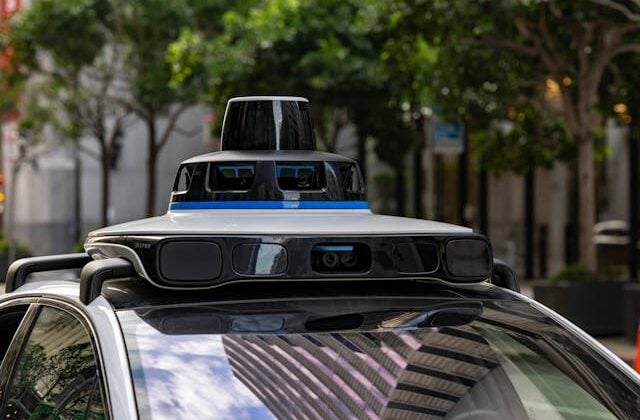
The case for lidar, as TechCrunch summarised when it reported those remarks, is that Uber, Waymo and Cruise use it because it perceives through difficult weather and low light better than cameras, the trade-off being expense and power draw.
Who wrote the Waymo safety paper
Waymo’s crash comparison is the most-cited safety evidence here, and it needs an accurate label. The paper compares rider-only crash rates to human benchmarks across 56.7 million rider-only miles, with a study period running through January 2025, and was accepted for publication in the journal Traffic Injury Prevention. Its authors are Kristofer D. Kusano, John M. Scanlon, Yin-Hsiu Chen, Timothy L. McMurry, Tilia Gode and Trent Victor, all of Waymo LLC in Mountain View, California. It is peer-reviewed, and it is authored entirely by employees of the company whose product is being evaluated.
The headline results are a 79 percent reduction in any-injury-reported crashes, an 81 percent reduction in airbag-deployment crashes and an 85 percent reduction in suspected-serious-injury-or-worse crashes against human benchmarks, all reported as statistically significant. Waymo’s marketing pages carry different percentages over a much larger mileage, so the two sets should not be mixed in one sentence.
The limitations the authors listed themselves
The paper’s own limitations section is more candid than most coverage of it.
- Benchmark adjustments for underreporting and dynamic spatial factors may mask remaining uncertainty in the human crash data
- Police reports have limited specificity and are subject to input error, particularly on crash-type classification
- The analysis did not account for Waymo’s different time-of-day driving pattern, which the authors say likely underestimates elevated crash risk
- The airbag and serious-injury benchmarks carry no underreporting adjustment, although underreporting likely exists
- Testing across 11 crash types, 3 outcomes and 4 locations raises false-positive risk, with no multiple-comparison correction applied
- Only 2 serious-injury crashes occurred, which limits statistical confidence despite the mileage
Sun glare, fog, and three NHTSA docket numbers
The National Highway Traffic Safety Administration opened preliminary evaluation PE24031 on 17 October 2024, covering approximately 2.41 million Tesla vehicles equipped with Full Self-Driving. Four crashes had been reported under the agency’s Standing General Order in conditions of sun glare, fog or airborne dust; one killed a pedestrian and another caused an injury. The alleged defect was recorded as a failure of the system engineering controls to react appropriately to reduced roadway visibility conditions.
A second file, PE25012, opened on 9 October 2025 and covers nearly 2.9 million vehicles and 58 reported safety violations, including more than a dozen crashes, fires and 23 injuries, with Full Self-Driving reported driving through red traffic signals and initiating lane changes into opposing traffic.
In March 2026 the agency upgraded PE24031 to engineering analysis EA26002, covering approximately 3.2 million vehicles, with the crash count expanded from four to nine plus six further potentially related cases including one fatality and one injury. Electrek reported the agency’s stated finding: that the system’s degradation detection did not detect common roadway conditions that impaired camera visibility, such as sun glare and fog, so drivers were not warned when the system’s vision was compromised. That is a regulator describing the exact failure mode lidar and radar proponents have argued for.
A recall over stopped school buses
The sensor-rich approach has its own documented failures. On 11 December 2025 Waymo recalled 3,067 vehicles. CBS News reported that software in certain fifth-generation automated driving systems caused vehicles to pass stopped school buses even with red lights flashing and stop arms extended, which the notice described as increasing the risk of a crash with a pedestrian. The recall carries NHTSA number 25E084000, from a notice dated 8 November, and Waymo said the affected vehicles were fixed by 17 November 2025. NHTSA opened a probe in October after a school bus incident in Atlanta, and the Austin Independent School District documented 20 illegal school-bus passes during the 2024 to 2025 school year, with one citation issued after Waymo said the issue had been resolved.
Tesla’s robotaxi service, launched in Austin in June 2025, has reported 14 crashes to NHTSA since launch: five in December and January, two earlier in July and October causing minor injuries, and the remainder property damage only. Shortly after launch the agency contacted Tesla about videos of erratic driving, including robotaxis on the wrong side of the road and braking suddenly. Those 14 crashes cannot be turned into a rate. The reporting gives no mileage denominator and does not say whether a safety monitor was aboard, so they cannot be set against Waymo’s per-million-mile figures, and anyone publishing that comparison has invented the missing number.
The cost half of the argument has collapsed
Musk’s 2019 objection had two parts, and they have aged differently. Hesai, the Chinese lidar manufacturer, has reduced the per-unit price of lidar from more than 50,000 US dollars a decade ago to around 200 dollars for its FTX solid-state sensor. Its 2025 results, reported by Automotive World, show 1.62 million units shipped, up 222.9 percent year on year, revenue of 3.03 billion yuan, up 45.8 percent, and net income of 435.9 million yuan, about 62.3 million US dollars, making it the first lidar maker to reach full-year profitability.
A 200 dollar sensor is not an argument-ending expense, so the cost half of the 2019 position no longer carries its weight. The necessity half remains genuinely open. No source consulted here settles whether a camera-only stack can match a redundant one; what exists is a regulator’s engineering analysis, self-published safety data from a company using all three sensor types, and recalls on both sides. Hold those separately rather than treating either as a verdict.
Sources: TechCrunch · CNBC · arXiv (Waymo LLC preprint, Traffic Injury Prevention) · NHTSA Office of Defects Investigation · Electrek · CBS News · Automotive World